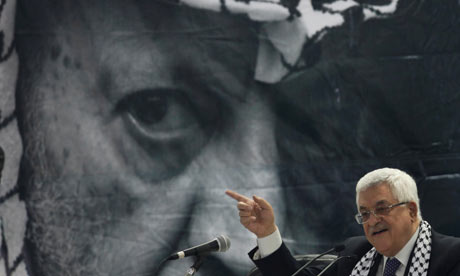
Abbass Overshadowed by Arafat!
On its second annual conference this week in Bethlehem, Fatah has no good options. It is squeezed between an occupation that demands that Palestinian territories be pacified and neutralized, and a populace skeptical of the Palestinian Authority's relationship with Washington and Tel Aviv. This “paradox of representation,” as Political Scientist Tamim Al-Barghouti coins it, came to the fore with Abbass’ takeover of power in Ramallah.
Arafat, the main founders of Fatah/ the Palestine Liberation Organization (PLO), spent much of his time in Ramallah balancing between the two opposites, however unsuccessfully. He signed several peace agreements, intermittently cracked down on Hamas and Islamic Jihad militants, and offered major concessions regarding Palestinian "rights" to historical Palestine. On the other hand, he aided and funded Fatah's militia "Al Aqsa Martyrs Brigades," turned down the Camp David Agreement (for arguably good reasons) and turned a blind eye to the eruption of Al Aqsa Intifada. The promise of establishing an independent Palestinian state was the foundation of his regime’s popularity, and for that he was, in effect, parachuted back to the Palestinian Territories from his Tunisian exile. His reign ended in besiegement, destruction of West Bank infrastructure and an ongoing occupation.
Since Arafat's death, Fatah has opted for better relations with America and Israel, even when a peace agreement could not be any further. Fatah consistently refused to join hands with the Gaza-based Hamas government, arrested Hamas militants in the West Bank, all but ended Al Aqsa Martyrs Brigades’ operations and launched numerous unsuccessful talks with Israeli officials. Seeing no material improvement in their living conditions, let alone a cessation of the Israeli occupation, Palestinians predictably turned towards the "resistance" paradigm of Hamas.
In its annual conference, Fatah appears perplexed, irrelevant and weak. First, Hamas banned Fatah members from travelling to the West Bank to attend the conference (until Ramallah has released Hamas detainees). Second, Farouq Al-Qaddumy, a senior Fatah official in Tunis, launched an unexpected attack on President Abbass prior to the conference, in which he accused him (and Fatah tycoon, Mohammed Dahlan) of collaborating with the Israelis to poison Yasser Arafat. Qaddumi blasted the Palestinian President, furthermore, for being corrupt, and having his forces trained by U.S. General Keith Dayton. Qaddumi's words mirror the substantial disenfranchisement felt by Palestinian refugees, particularly those who are members of Fatah. Third, many Fatah members are dismayed with the appointment of the non-partisan Salam Fayyad, as head of the West Bank Palestinian government. This appointment denied them many of the benefits associated with running a government that relies financially on foreign aid. The discontent goes beyond Fayyad, to be sure. There is an old guard-new guard rivalry within Fatah, and, more significantly, there is disenchantment with Abbass' seemingly futile all-dialogue all-the-time approach towards Israel.
On its part, Hamas not only blocked Gazan Fathawis from travelling, but launched severe criticisms of its rival in the West Bank. Most of the criticism, nonetheless, was directed at Abbass who was accused of abandoning the "Palestinian national project... and national goals." Fawzi Barhoum, senior Hamas official, claimed Fatah assisted Israel in its recent war on Gaza. Abbass had, in fact, attacked Hamas on the conference's first day, accusing it of "darkness and terrorism" as well as plotting to assassinate him. Fatah’s predicament is Palestinians are more likely to find more truth in Hamas’ accusations of Abbass than the other way around.
The overarching question the Palestinian President (whose constitutional term in office ended last January) had to answer in the conference is: what is the future of the national liberation movement of Palestine? On that, his answer, for many Palestinians, left a lot to be desired. Abbass emphasized principally diplomacy, and, to a lesser extent, the exclusive concept of "legitimate" resistance. The foregoing concept is unlikely to find much popular backing, as they have come to see the West Bank government forces, as instruments to crack down on the classical resistance model of “armed struggle.” The President’s outspoken attack on Hamas, and implicitly other militants, reveals Abbass' desire to mend his own fences before solidifying a united national front. To be sure, a Fatah divided house cannot make peace with Hamas. Nevertheless, Abbass sounded more like a partisan figure than a national leader. This does not bode well either for the future of Fatah or that of the seemingly endless Cairo reconciliation talks with Hamas.
During the Gaza war, Tel Aviv and Washington quickly realized the full extent of Fatah's irrelevance. Hamas was calling the shots. Fatah could not be relied on to topple Hamas, or even assume power, if Israel did the job. If Israel wants a solution to the missile crisis in Gaza, it must negotiate with the Islamic Resistance Movement, Hamas. After the conference ends, Fatah would be as irrelevant as ever. It will continue to suffer the debilitating legitimacy crisis it has been experiencing, since Arafat’s death. The Palestinian electorate may not be so kind to Abbass’ party in the next parliamentary elections next year. If Fatah is to make gains, it seems it would be the fruit of Hamas’ own making.
Here is the full text of Abbass' conference speech.

