Showing posts with label Hamas. Show all posts

August 5, 2009

Between a Rock and a Hard Place!


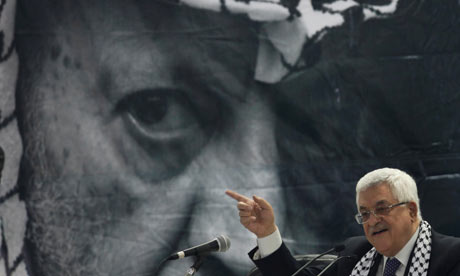
Abbass Overshadowed by Arafat!

On its second annual conference this week in Bethlehem, Fatah has no good options. It is squeezed between an occupation that demands that Palestinian territories be pacified and neutralized, and a populace skeptical of the Palestinian Authority's relationship with Washington and Tel Aviv. This “paradox of representation,” as Political Scientist Tamim Al-Barghouti coins it, came to the fore with Abbass’ takeover of power in Ramallah.

Arafat, the main founders of Fatah/ the Palestine Liberation Organization (PLO), spent much of his time in Ramallah balancing between the two opposites, however unsuccessfully. He signed several peace agreements, intermittently cracked down on Hamas and Islamic Jihad militants, and offered major concessions regarding Palestinian "rights" to historical Palestine. On the other hand, he aided and funded Fatah's militia "Al Aqsa Martyrs Brigades," turned down the Camp David Agreement (for arguably good reasons) and turned a blind eye to the eruption of Al Aqsa Intifada. The promise of establishing an independent Palestinian state was the foundation of his regime’s popularity, and for that he was, in effect, parachuted back to the Palestinian Territories from his Tunisian exile. His reign ended in besiegement, destruction of West Bank infrastructure and an ongoing occupation.

Since Arafat's death, Fatah has opted for better relations with America and Israel, even when a peace agreement could not be any further. Fatah consistently refused to join hands with the Gaza-based Hamas government, arrested Hamas militants in the West Bank, all but ended Al Aqsa Martyrs Brigades’ operations and launched numerous unsuccessful talks with Israeli officials. Seeing no material improvement in their living conditions, let alone a cessation of the Israeli occupation, Palestinians predictably turned towards the "resistance" paradigm of Hamas.

In its annual conference, Fatah appears perplexed, irrelevant and weak. First, Hamas banned Fatah members from travelling to the West Bank to attend the conference (until Ramallah has released Hamas detainees). Second, Farouq Al-Qaddumy, a senior Fatah official in Tunis, launched an unexpected attack on President Abbass prior to the conference, in which he accused him (and Fatah tycoon, Mohammed Dahlan) of collaborating with the Israelis to poison Yasser Arafat. Qaddumi blasted the Palestinian President, furthermore, for being corrupt, and having his forces trained by U.S. General Keith Dayton. Qaddumi's words mirror the substantial disenfranchisement felt by Palestinian refugees, particularly those who are members of Fatah. Third, many Fatah members are dismayed with the appointment of the non-partisan Salam Fayyad, as head of the West Bank Palestinian government. This appointment denied them many of the benefits associated with running a government that relies financially on foreign aid. The discontent goes beyond Fayyad, to be sure. There is an old guard-new guard rivalry within Fatah, and, more significantly, there is disenchantment with Abbass' seemingly futile all-dialogue all-the-time approach towards Israel.

On its part, Hamas not only blocked Gazan Fathawis from travelling, but launched severe criticisms of its rival in the West Bank. Most of the criticism, nonetheless, was directed at Abbass who was accused of abandoning the "Palestinian national project... and national goals." Fawzi Barhoum, senior Hamas official, claimed Fatah assisted Israel in its recent war on Gaza. Abbass had, in fact, attacked Hamas on the conference's first day, accusing it of "darkness and terrorism" as well as plotting to assassinate him. Fatah’s predicament is Palestinians are more likely to find more truth in Hamas’ accusations of Abbass than the other way around.

The overarching question the Palestinian President (whose constitutional term in office ended last January) had to answer in the conference is: what is the future of the national liberation movement of Palestine? On that, his answer, for many Palestinians, left a lot to be desired. Abbass emphasized principally diplomacy, and, to a lesser extent, the exclusive concept of "legitimate" resistance. The foregoing concept is unlikely to find much popular backing, as they have come to see the West Bank government forces, as instruments to crack down on the classical resistance model of “armed struggle.” The President’s outspoken attack on Hamas, and implicitly other militants, reveals Abbass' desire to mend his own fences before solidifying a united national front. To be sure, a Fatah divided house cannot make peace with Hamas. Nevertheless, Abbass sounded more like a partisan figure than a national leader. This does not bode well either for the future of Fatah or that of the seemingly endless Cairo reconciliation talks with Hamas.

During the Gaza war, Tel Aviv and Washington quickly realized the full extent of Fatah's irrelevance. Hamas was calling the shots. Fatah could not be relied on to topple Hamas, or even assume power, if Israel did the job. If Israel wants a solution to the missile crisis in Gaza, it must negotiate with the Islamic Resistance Movement, Hamas. After the conference ends, Fatah would be as irrelevant as ever. It will continue to suffer the debilitating legitimacy crisis it has been experiencing, since Arafat’s death. The Palestinian electorate may not be so kind to Abbass’ party in the next parliamentary elections next year. If Fatah is to make gains, it seems it would be the fruit of Hamas’ own making.

Here is the full text of Abbass' conference speech.

July 10, 2009

And the Dam Cracks...


(British Ambassador Frances Guy veiled for a meeting with Lebanese Shiite Spiritual leader Sayyed Muhammed Hussein Fadlallah, regarded by many as religious figurehead for Hizbullah's followers) 

After eight long years of mixing oranges and apples, the Europeans appear to have finally learned the distinctions between constituency-based and societally-active Islamist militant movements, on the one hand, and takfiri, transnational terrorist groups, on the other. The former, notably Hizbullah and Hamas, have grievances founded primarily on nationalist grounds. These grievances relate, for the most part, to their nations' loss of land in previous armed confrontations with Israel. Their overriding objective is to reclaim of these territories, as well as gain political power. The latter, however, is interested in a much grander project that finds little sympathy amongst Muslims. The Al-Qaeda-types seek to depose all heads of state in the Muslim world, get rid of foreign occupation, and establish a Caliphate system. In pursuit of these objectives, takfiri groups have no qualm about murduring every one standing in the way, Muslims and non-Muslims alike.

That the differences are glaring between both camps is easy to conclude. Nevertheless, Western government have long refused to acknowledge, at least not publicly, the differences, preferring to lump all militant Islamist groups in an uneasy monloithic bloc. In some instances, non-violent Islamist parties, such as the Muslim Brotherhood, were thrown into the mix.

It is no secret that the aforementioned strategy have not yielded progress on any front. The situations in Iraq, Afghanistan, Gaza and Lebanon are virtually the same now as they were a few years ago. But we might be witnessing a reverse of the tide. On June 9th, Hizbullah Member of Parliament, Muhammad Ra'd, held a 2 hour meeting with a British parliamentary delegation, accompanied by the British ambassador in Beirut, Frances Guy. The delegation included members of Britain's three largest political parties, the Labor, the Conservative and the Liberal Democratic parties. Ambassador Guy had previously met with MP Ra'd last month.

Yesterday, French Foreign Minister, Bernard Kouchner, announced his intent to meet with representatives from the Shi'a Lebanese militant party. If the meeting does take place, it would be the first such meeting between a high-level European diplomat, and a member of a group identified by the US State Department as a terrorist organization. Meanwhile, there are rumors that the EU's High Representative for the Common Foreign and Security Policy, Javier Solana, will be meeting soon with Hizbullah's Hussein Al Hajj Hassan. There is definitely no dearth of Europeans meeting with Hizbullah.

Could it be that the Europeans have suddenly become more nuanced in their foreign policy posture towards the Middle East, whereas the United States has not? Probably not. I think the Obama administration is already stretching the limits of its domestic constituencies by appointing an ambassador to Syria, seeking dialogue with Tehran and opposing expanding Israeli settlements. Washington may have tacitly supported this engagement process, which the US itself cannot pursue, to test the waters, and see how much can be agreed on diplomatically with Hizbullah. After all, Hizbullah is not on the EU's list of terrorist organizations.

I would like very much to hear your thoughts on the reasons behind this series of meetings between European diplomats and Hizbullah members of parliament. 

July 1, 2009

You did it! No, You did it!

Fatah and Hamas are back to their childish finger-pointing; this time over the issue of political prisoners. The "national reconciliation" talks between the two movements have been conducted in Cairo for several months now, with few signs of progress.

Egypt has been hosting the soap opera-like negotiations to prove the reselince of its (ever-diminishing) regional role. Mubarak also wishes to undo some of the political damage he sustained for helping Israel blockade Gaza during the Gaza Offensive and beyond. The latter policy proved neither effective in toppling Hamas from power (a goal espoused by Cairo for the last two years), nor particularly popular in the Muslim world. In fact, the Egyptian regime was decried by protesters around the world, and widely vilified on Al Jazeera's coverage of the war. The latest news from Cairo, however, reveals the country's continuing inability to mediate regional conflicts as efficiently as the mini-state of Qatar (the host and funder of Al Jazeera News Network) does.

If you expected the irreconcilable differences between Hamas and Fatah to be regarding recognition of Israel, the role and membership of the Palestine Liberation Organization, the formation of national unity government, etc., you'd be mistaken. While the two parties struggle to find common ground on these issues, Hamas and Fatah have been apparetnly arresting each other, even as "national reconciliation" talks are held. Negotiation experts would probably define this as a non-confidence-building measure. Ismail Haniyeh, the Hamas Gaza-based prime-minister, blamed the failure of the negotiations on Fatah's "intransigence" regarding the release of Hamas political prisoners (Hamas activists and militants detained by Ramallah's security forces). Haniyeh went on to blast his "brothers in Fatah" for being controlled by the demands of Israel and the United States. Fatah has recently launched a crackdown on some Hamas figures in the West Bank, resulting in the infamous Qalqilya incident. Shortly after the collapse of the talks, it was reported that 10 Hamas members were rounded up in the West Bank on the claim they were planning attacks against Ramallah government figures. Yet, Fatah insisted that some 468 of its memebers are alreadly held by Hamas (a charge Hamas denies), and Presdient Abbass held the Islamist movement responsible for the talks' failure by prioritizing "factional interests" over national reconciliation.

The talks were supposed to end on July 7th with a national unity agreement. Instead, the news came from Cairo that July 25th-28th is the new date for yet another round of talks. This hardly comes as a surprise. Not only has Egypt failed to play an active mediating role conducive to an agreement, but in many cases Cairo blatantly took the side of Fatah.

The Palestinian factions have their own reasons for perpetuating the status quo as well. Hamas wishes to reinforce itself as a fact of life in Gaza. In other words, the longer Hamas clings onto power in the Strip, the more likely that Ramallah, Tel Aviv and Washington would have to accept the organization as a partner in a future peace agreement. Hamas may also be cherishing the victim's image that boosts its popularity among Palestinians, whilst depicting its secular rival as a stooge for the Israeli occupation. On the other hand, Fatah is adamant to demonstrate its relevance. The secular organization's populartiy is sagging, its reach of authority is confined, and its internal cohesion is in question. Abbass and the Fayyad government are trying to remain relevant by showing their ability to counter Hamas' growing influence in the West Bank. Abbass, after all, knows he is the preffered peace partner.

I would like to hear your thoughts on how Arab-Israeli peace can be reached in light of the ongoing rift between the two main Palestinian parties. Or can it be reached with two different authorities?